The case Australia couldn’t stop talking about
In July 2023, a woman in a small town in country Victoria served beef Wellington to four guests at a family lunch. Three of her guests died within a week. The fourth survived, but only after weeks in hospital fighting for his life.
Early reporting made it sound like a terrible accident. But as further details started to trickle out, an entire country became obsessed.
Water cooler conversations that would normally be about weekend plans or the latest show on Netflix were suddenly about dehydrators and different-coloured plates. Dedicated Facebook groups and Reddit threads dissected every detail. YouTube filled with self-proclaimed body language experts analysing every movement, motion and word of the accused. TikTokers and Instagrammers weighed in. The Mushroom Case Daily podcast became one of the top five podcasts in the country. International media covered the case.
My work friends and I were just as obsessed with the case as many other people were. We spent many lunch breaks out in the sunshine, dissecting the latest witness testimony, how it connected to what had come before, what the newspapers were reporting accurately and what they were getting wrong. I read everything I could get my hands on. When the trial began, I followed the live blogs daily.
I think what drew so many people to this case was that it just didn’t appear to make sense. Here was a woman who appeared to be living a normal life in a quiet country town. Three people died after eating at her home, and she was charged with murdering them. It all seemed so illogical. No apparent motive. No financial gain. No proven act of rage or revenge. This made the case simultaneously more compelling and more confusing. You couldn’t file it away in your head because there was no drawer to put it in.
And the evidence. The more that emerged, the stranger it got. Mushrooms as a murder weapon. So many electronic devices it was hard to keep up. A phone that was factory reset while it was in police custody, and the accused, Erin Patterson, as the sole witness for the defence.
When the verdict came down in July 2025 - guilty on all counts - a flurry of books followed quickly. The level of public interest was enormous, and publishers moved fast. I read a number of these books, but was disappointed. They didn’t explain the case in the way I had hoped, and I felt they didn’t do the forensics and digital evidence justice. The nuances of how investigators tracked the phone. The complexities of analysing the toxins. These elements were at the heart of the prosecution case. They deserved to be unpacked properly.
So I took the leap from reader to author…I wrote the book that I had hoped to find on this case, but couldn’t.
I am not a journalist. I am not a lawyer. But I do have a Masters degree in Information Technology, so I understood the technical and digital evidence. I spent almost a year writing this book. I researched court documents and judgements, evidence, forensic records, and contemporaneous reporting. I meticulously cross-referenced everything I could find, and built the story from the ground up - in the order it actually happened, with the complex evidence properly explained.
The resulting book, Fatal Lunch: The Death Cap Mushroom Murders, is now available on Amazon in Kindle, paperback, and audiobook. Also available on Spotify, Apple and in all good bookstores.
She Wiped Her Phone From Inside a Police Evidence Locker
In July 2023, three people died after eating beef Wellington at a family lunch in rural Victoria. The cook, Erin Patterson, was convicted of triple murder, though no motive was ever proven. Her conviction is now under appeal.
What gripped the public - and the jury - wasn’t just the mushroom mystery. It was the digital evidence: the phones, the searches, the resets, and the devices that vanished.
Three Phones, One Story
To make sense of the digital trail, you first have to understand Erin’s phones. She didn’t have one. She had several - and her SIM card moved between them like a traveller changing hotels.
The phone prosecutors cared about most - the one she allegedly used during months of death cap research - was never found. Its search history disappeared with it.
When police raided her home on 5 August 2023, Erin handed over a phone. But prosecutors argued it wasn’t her real phone at all -it was a decoy. Around that same time, she had taken her main SIM and placed it into an old Nokia. Neither the Nokia nor her primary Samsung were ever found.
The phone she did give police turned out to have its own secrets.
Four Resets, Four Moments
Digital forensics can reveal not just what was on a device, but when it was wiped. Victoria Police forensic officer Shamen Fox‑Henry examined Erin’s surrendered phone using Magnet Axiom, a specialist forensic platform. Even though the phone had been wiped repeatedly, the resets left timestamps -breadcrumbs that couldn’t be erased.
The phone had been factory reset four times:
12 February 2023 - Erin said she reset it to clear data her son had put on the phone.
2 August 2023, 11:09 a.m. - Minutes before CCTV captured her dumping a food dehydrator at a waste station. Her lunch guests were in intensive care at the time. She said the phone had been dropped in mud at school camp.
5 August 2023, 1:20 p.m. - While police were inside her home. She admitted she panicked because the phone contained photos of mushrooms and a dehydrator.
6 August 2023, 5:16 a.m. - The reset that made investigators stop in their tracks.
5:16 a.m. - The Reset From the Evidence Locker
The morning after the police search, Erin logged into her Samsung Find account - the service that lets users locate or remotely wipe their devices. She could see that the phone she’d handed over was still connected to the internet.
So she wiped it.
At that moment, the phone was sealed inside an evidence bag in a police locker.
At trial, Erin said she was curious whether police had “been silly enough to leave it connected to the internet,” and pressed the button to see what would happen. She called it “stupid.”
The jury heard her explanation. They also heard the time: 5:16 a.m. They drew their own conclusions about why someone might remotely erase a phone held by investigators before dawn.
What the Devices Still Remembered
Even with the phone resets, the digital trail wasn’t completely cold. Fox‑Henry’s analysis of other devices - including a Cooler Master computer stashed away in a wardrobe and a Samsung tablet - recovered browser histories, cached files, photos, and chat logs. The prosecution leaned heavily on this material.
This evidence, and how it shaped the case, is explored in Fatal Lunch: The Death Cap Mushroom Murders, a year‑long reconstruction built from court documents, testimony, and forensic records.
Digital evidence is now central to Erin Patterson’s appeal. She argues that some of it - such as cell tower location data and Facebook messages - should never have been admitted. The appeal is scheduled for August 2026.
Author, Cheryl Warren, holds a Masters in IT. She spent a year meticulously working through the case’s digital evidence for Fatal Lunch. Her technical background made it possible to turn a tangle of resets, SIM swaps, and other technical evidence into a sensible narrative.
Fatal Lunch is available on Amazon in Kindle and paperback. (Audiobook coming soon).
The Australian Poisoning Case That Shocked the World - What the Trial Record Actually Revealed
A family lunch in rural Australia. Three dead. One survivor. Nine weeks of trial. Here is what the court record actually revealed about the case that gripped the world.

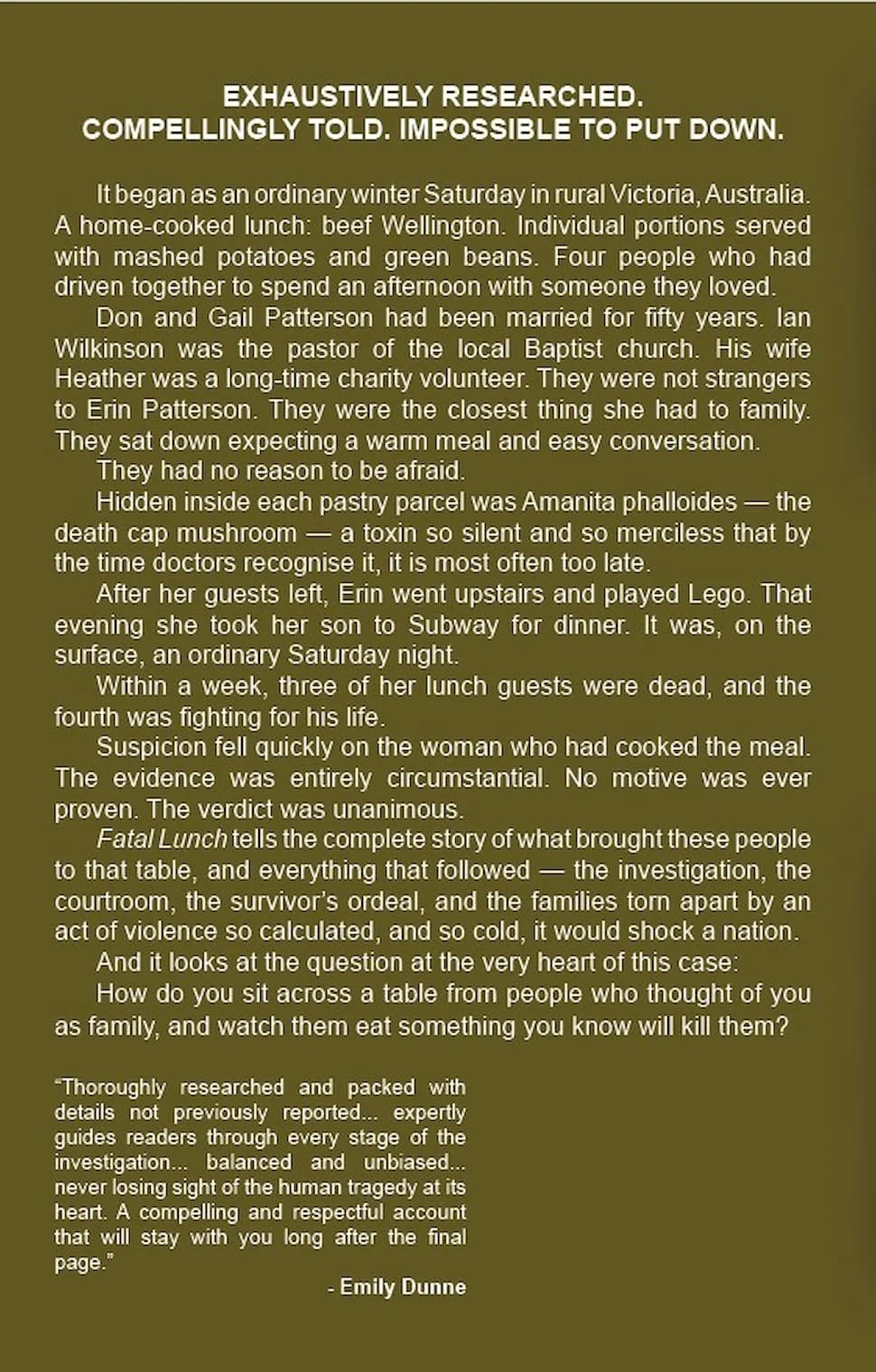
On 29 July 2023, a woman named Erin Patterson invited four members of her estranged husband's family to lunch at her home in Leongatha, a quiet town in rural Victoria, Australia. She served individual beef Wellingtons. Within days, three of her guests were dead.
The case became one of the most followed criminal trials in recent memory. The BBC live-blogged the verdict. CNN, NBC, Al Jazeera, and Reuters ran major features. Millions of Australians followed daily podcast summaries of the proceedings. For the first time in the history of Victoria's Supreme Court, the sentencing hearing was broadcast live - the public interest was that intense.
But most of the coverage moved fast. Headlines captured the broad strokes. The detail - the forensic trail, the digital evidence, the eight days the accused spent in the witness box - got less attention than it deserved.
I spent the better part of a year reading everything I could find. The court judgements. The judge's sentencing remarks. The evidence presented in court - including incredibly complex, but interesting, forensic evidence. The daily trial blogs that documented every witness, every cross-examination, every piece of evidence the jury heard. I wrote a book about it. And what I found in the detail was a story far more complex than the headlines suggested.
Here is some of what the trial record actually revealed.
The Dehydrator
A food dehydrator was central to the prosecution's case. Prosecutors argued Patterson used it to dry the death cap mushrooms before incorporating them into the beef Wellington filling.
Five days after the lunch - while her guests were fighting for their lives in hospital - Patterson drove to the local tip and disposed of the dehydrator in the e-waste skip. CCTV footage captured her there. Police recovered the dehydrator.
Forensic testing of debris scraped from the dehydrator trays used DNA barcoding - a technique that matches genetic material to known species. Two of the seven samples returned a 99 per cent match to Amanita phalloides. Death cap mushroom.
The defence did not challenge those findings.
The Phones
The digital evidence in this case is a story in itself.
Patterson had a primary phone - Phone A - that she had used since 2021. During the first police search of her home, carrier records showed it was still active on the network. Then it dropped off. It was never found.
What Patterson handed police was a different device - Phone B - that had made a total of three calls in its entire existence, all three on the day of the search. Phone B was factory reset three times in August 2023 alone. The final reset came at 5:16am while the phone was sitting inside a police evidence locker. Patterson later told the court she had logged into her Samsung account remotely and wanted to see if a reset would work.
It did.
A third phone - Phone C - briefly carried the SIM card from Phone A after the search, then also disappeared from the network. Neither Phone A nor Phone C were ever recovered.
The Plates
One of the quieter but more striking details from the trial concerned the plates.
Ian Wilkinson - the only survivor - described the meal being served on four large grey plates and one smaller, different-coloured plate. An orangey-tan colour. His wife Heather had noticed the different plate and commented on it.
The prosecution argued this was how Patterson controlled which portion was safe - the different plate was hers. Patterson maintained the plates were simply what she had available.
The jury heard both versions.
The Health Department Trail
In the days after the lunch, the Victorian Health Department launched an urgent investigation to identify the source of the mushrooms. Four people were critically ill. They needed to know if there was a public health risk.
Patterson was difficult to reach. When they finally spoke with her, she told them the mushrooms came from an Asian grocer in Oakleigh or Clayton. Then it became Mount Waverley. Then Glen Waverley. Health officials checked every store they could find. Nothing matched. No other poisonings had been reported anywhere.
By 11 August they formally concluded the commercial food supply chain was not contaminated.
The prosecution later argued Patterson had sent them on a deliberate wild goose chase while her guests lay dying.
The Verdict
The trial ran for nine weeks. More than fifty witnesses gave evidence. Patterson spent eight days in the witness box - five of them under cross-examination. The jury deliberated for approximately thirty hours over six and a half days.
The foreperson stood and read the verdicts. Guilty. Four times.
No motive was ever proven. The entire case was circumstantial. And yet twelve jurors reached the same conclusion unanimously.
Patterson was sentenced to life imprisonment with a non-parole period of thirty-three years. The sentencing was broadcast live - the first time in Victoria's Supreme Court history.
Both the prosecution and the defence have now appealed. The story is not over.