Fatal Lunch: The Death Cap Mushroom Murders
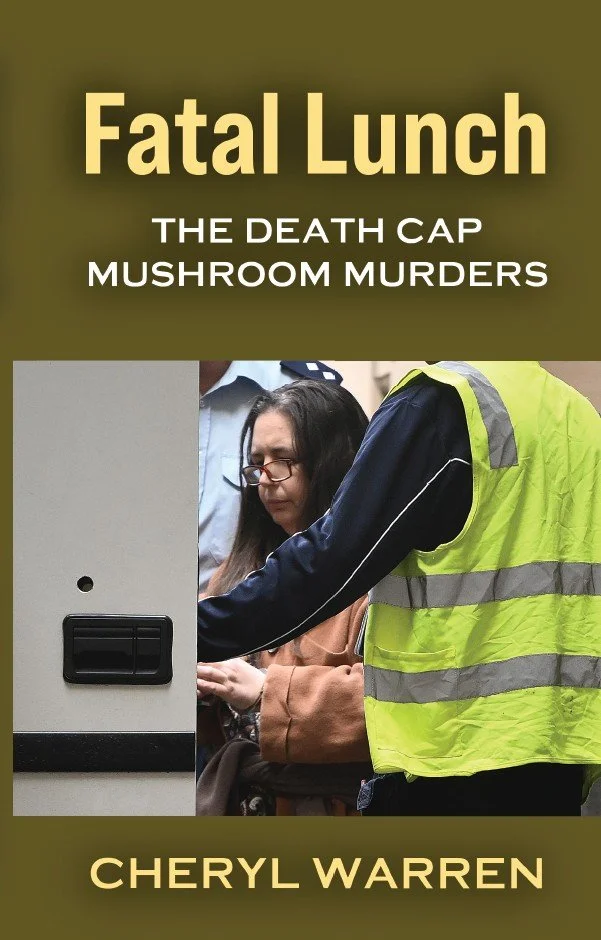
On 29 July 2023, Erin Patterson invited four members of her estranged husband's family to lunch at her home in Leongatha, a quiet town in rural Victoria, Australia. She served individual beef Wellingtons. Within days, three of her guests - her mother-in-law Gail, father-in-law Don, and Gail's sister Heather - were dead from death cap mushroom poisoning. The fourth guest, Ian Wilkinson, survived after weeks in hospital.
What followed was one of the most closely watched criminal investigations in Australian history. A food dehydrator dumped at a local garbage tip. A phone reset multiple times. A fake cancer diagnosis. A woman who insisted it was all a terrible accident.
After a ten-week trial - including over a week on the witness stand herself - Erin Trudi Patterson was found guilty on all counts. She was sentenced to life in prison with a non-parole period of thirty-three years. Her conviction is currently under appeal.
When I started writing Fatal Lunch, the case already belonged to everyone. It had become a thousand headlines, a hundred theories, and an endless scroll of online speculation - a story people felt they already knew.
I wrote this book because I believed the facts deserved better than the endless noise that had grown around them. Daily saturation coverage comes at a cost: evidence emerged in fragments, out of sequence, often contradicting what had been reported the day before. By the time the verdict was handed down, many people who had followed the case closely still couldn't explain how the prosecution had proved its case, or why the defence arguments failed - and the people at the centre of it had been flattened into a plot.
Fatal Lunch is the slow work this case deserved.
Twelve months of careful research, facts drawn from court documents, trial testimony, forensic records and verified contemporaneous reporting - written after the trial concluded, after the evidence was tested.
This book separates what was established from what was merely repeated. It reconstructs the complete story in the sequence it actually happened, not the sequence it was reported. It helps the reader understand who these people were before they sat down at that table. And where the record is silent, I left it silent. Restraint, I've come to believe, is not the absence of storytelling. It is a form of respect.
The forensic evidence that confused so many - the mushroom toxicology, the liver pathology, the phone and internet records - is explained in plain language, because setting facts out carefully in their proper order is what makes complex evidence finally make sense.
My professional background helped: I hold a Masters in IT, so the digital evidence was home ground. But the deeper question that drove the writing is the one that drives all serious true crime - what brings a seemingly ordinary person to an extraordinary crime, and what it means for the family and community left behind.
This is my first book, written the way I intend to write every one that follows: patiently, precisely, and with care for the people whose lives the story touches.
Published by Sharp Kestrel. Available in paperback, Kindle and audiobook.
cheryl@cherylwarrenauthor.com